
News from the movement
Architects of education. Or architects of our lives?
Mantvydas P. · · 21 min read
In my manifesto, I use a famous quote: “You live, you learn.”
And I genuinely believe that learning and education are as broad as life itself. We learn through everything we experience, every mistake we make, every person we meet, every question we ask, and every decision we take. Learning does not begin when we enter a classroom, nor does it end when someone hands us a diploma. Living is learning. Learning is living. They are not two separate activities. They are the same continuous human experience.
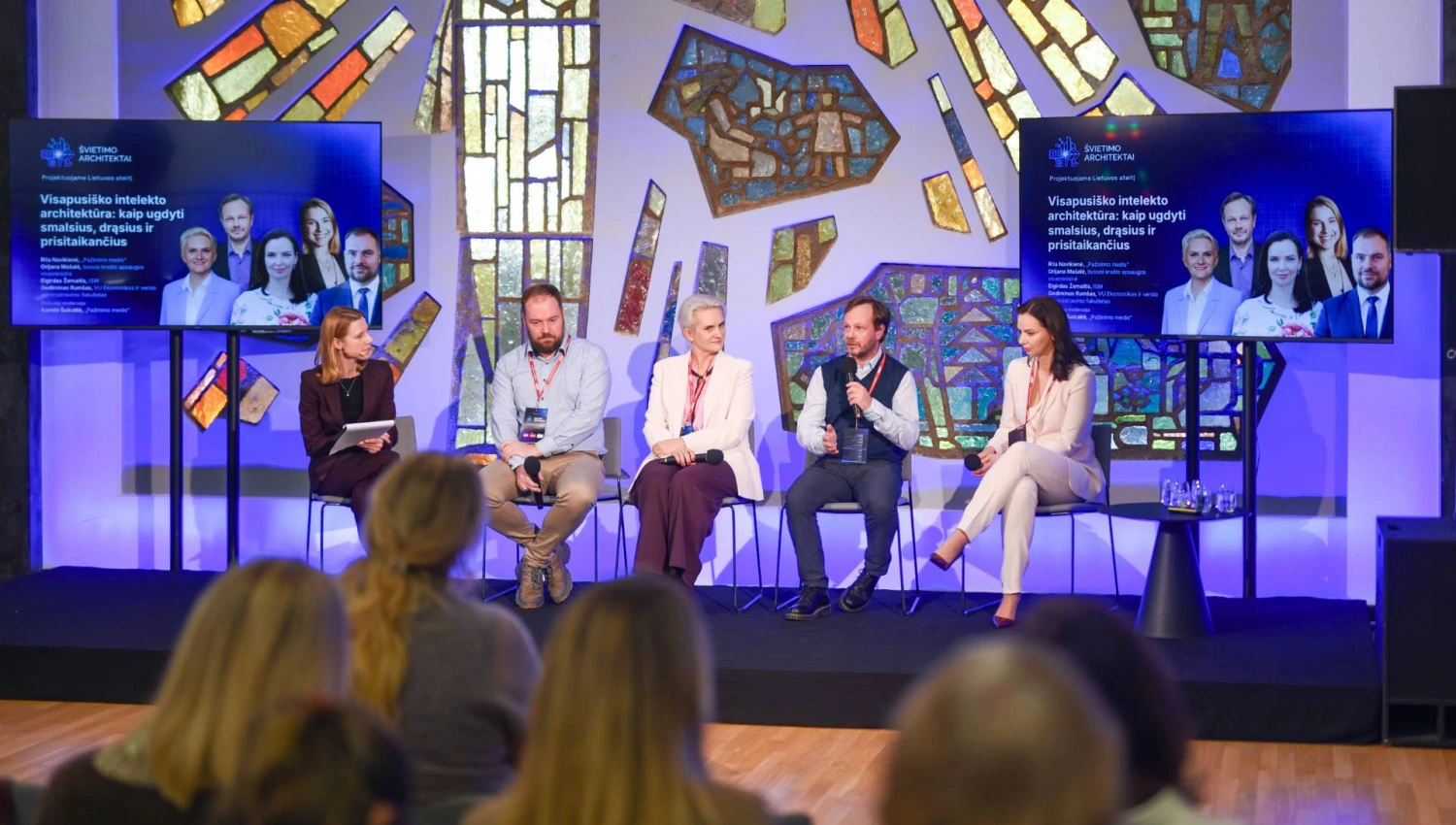
Which brings me to an event in Vilnius called Architects of Education.
My friend and Learning Movement co-founder Diana seems to appreciate the name. I deeply dislike it. Because to me, “Architects of Education” is simply another way of saying “Architects of Life.” Not metaphorically. Quite literally.
If education is the process through which we learn to understand ourselves, other people, and the world around us, then designing education means designing how people experience and navigate life itself. A group of people, no inherently wiser than you or me, gathering to discuss how other human beings should learn, think, develop, and live. They are not merely discussing the architecture of education. They are discussing the architecture of human life.
And what gives them that authority? A position? A title? A diploma? A sufficiently impressive LinkedIn profile?
Apparently, having the right credentials means you are qualified not only to make decisions about your own life, but to “help” design everyone else’s. How reassuring.
I wonder when exactly we agreed that a handful of people with impressive titles, but no greater claim to wisdom than the rest of us, should be entitled to architect the lives of millions who never asked them to.
And before someone objects that education is not the same as life, I invite them to consider how much of a young person’s life is spent in compulsory education, how much of their future depends on the credentials it awards, and how many opportunities are denied to those who refuse or fail to follow its prescribed path.
But also consider how much we learn outside formal institutions. From our parents, friends, relationships, work, failures, travels, books, conversations, personal interests, and simply being alive. We continue learning every day, long after our formal education is supposedly complete.
Who decided that learning becomes education only when it happens inside an approved institution, under an approved professional, following an approved curriculum?
We are discussing a system that can determine where people must spend their childhood, what they must study, how they are judged, and which doors will open or remain closed afterward. And this raises a question that I find increasingly difficult to ignore.
Why does something as fundamental, individual, and universal as learning need to be systematised in the first place?
Especially today. We live in a world where information is available almost instantly. Where practically anyone with an internet connection can access books, lectures, scientific research, courses, tutorials, and increasingly powerful artificial intelligence capable of explaining almost anything in a personalised way. Never in human history have individuals had such extraordinary access to knowledge.
And yet we continue to insist that learning must largely take place through institutions, fixed programmes, prescribed subjects, standardised assessments, and credentials issued by authorised organisations.
Why?
Why are we still treating access to knowledge as if it were scarce and required institutional gatekeepers? Why are we so obsessed with organising, measuring, controlling, and certifying something that human beings do naturally throughout their entire lives?
Schools, universities, and teachers can provide tremendous value. But offering education and imposing an educational system are two completely different things. Why must one particular model of learning be imposed on everyone, rather than offered as one of many legitimate choices?
If learning is inseparable from life, why have we allowed others to design so much of it for us?
A memory I never forgot
I went to the conference expecting it to be bad. The name already told me quite a lot about what to expect. And given my opinion of the educational system itself, I was hardly anticipating an intellectual revolution.
But something happened before I even arrived.
While waiting for a bus, I unexpectedly saw someone I have thought about almost every day since my school and university years. Not a forgotten memory suddenly returning. Quite the opposite. A memory that never really left me.
You see, when I think back on all those years spent in educational institutions, I struggle to recall even one genuinely happy memory. Except for one.
And there, just behind me at an ordinary bus stop, was the person behind that memory.
There was something almost absurdly appropriate about it. After all those years of classrooms, lectures, examinations, and grades, the one thing that has stayed with me more than anything else had almost nothing to do with what those institutions were supposedly there to teach.
Not a brilliant lecture. Not an inspiring professor. Not some academic achievement. Something human. Something that happened naturally, without anyone planning, measuring, assessing, or “architecting” it. Something that belonged to life itself, not to any curriculum.
And perhaps that says more about what those years truly meant to me than any academic qualification ever could.
I had not even reached the conference, and life had already given me the most meaningful moment of the day. Then I went to listen to the “architects” explain how the rest of it should be organised.
The venue was probably the best part
The conference was held at the Lithuanian National Martynas Mažvydas Library in Vilnius. And this was one part of the event I was genuinely interested in.
Established in 1919, the National Library is named after Martynas Mažvydas, who prepared the first printed Lithuanian-language book, Catechismusa prasty szadei (Catechism), published in Königsberg in 1547. Its collections include rare manuscripts, historical documents, and books dating back centuries.
As someone who collects antique books, I find this fascinating. In fact, I own something even older than Mažvydas’s famous book: a Bible printed in Lyon, France, in 1510. That is seven years before Martin Luther published his Ninety-five Theses, traditionally marking the beginning of the Protestant Reformation.
I mention Luther in my manifesto too, drawing parallels between today’s education system and the religious institutions he challenged, including the system of indulgences. The authority to determine what people should believe, the institutions claiming exclusive legitimacy, and the credentials people are expected to obtain to prove their worth. Different centuries, remarkably familiar ideas.
And here is another irony: my Bible was printed in Lyon, the very same city where, more than five centuries later, students are protesting, schools are being blockaded, and serious unrest is taking place.
What fascinates me most is imagining how much of the world that book has seen.
More than five hundred years of history. Religious revolutions, wars, empires rising and collapsing, industrialisation, electricity, automobiles, computers, the internet, and now artificial intelligence. How many hands has it passed through? How many people have read its pages? What did they believe about the world, and what could they never have imagined was coming?
Generations have lived, learned, and died while that book continued to exist. In a sense, it has lived and learned alongside humanity for more than five centuries.
And there is something deeply ironic about discussing how to architect other people’s lives inside a library dedicated to preserving centuries of human knowledge. Knowledge created by people who questioned, discovered, challenged, experimented, and lived.
Not all of them followed an approved curriculum. Not all of them had the right credentials. And many of the ideas that transformed humanity were once considered dangerous precisely because they challenged the institutions that claimed authority over knowledge.
Perhaps our educational “architects” could learn something from that history. Assuming, of course, that it is included in the curriculum.
As predictable as the system itself
As I expected, the conference offered little that fundamentally challenged the existing model of education. There were familiar conversations about the future, innovation, leadership, technology, and the relationship between schools and businesses.
Artificial intelligence, naturally, occupied its familiar place in the discussion. We live in the age of AI. Schools must adapt. Businesses must adapt. Teachers must adapt. Students must learn to use AI responsibly, understand the risks, and prepare for a rapidly changing labour market.
And, of course, we need more innovation. Innovation. Innovation. Innovation. Preferably delivered through a PowerPoint presentation by someone with a very impressive job title.
To be fair, some of the ideas presented were reasonable. Some were even genuinely positive. Encouraging curiosity, independent thinking, creativity, adaptability, and better use of technology are all things I can agree with.
But almost every positive idea was presented through the perspective of the existing educational system.
And that is precisely the problem. Instead of asking how individuals could pursue these things independently, the conversation kept returning to how schools, universities, and other institutions could provide them.
So, to receive these benefits, people are still expected to accept the entire institutional package. The compulsory structures, the prescribed programmes, the standardisation, the assessments, the credentialism, and all the other restrictions that come with it.
To get the positives, you are expected to swallow the negatives too.
Why? Why should someone who wants to learn, develop their curiosity, or become competent in a particular field have to accept an entire educational system just to access the parts that are actually useful to them?
Imagine being offered something genuinely valuable, but being told that to receive it, you must first agree to years of obligations, restrictions, and procedures that you never wanted. And then being congratulated for having the freedom to choose. How generous.
Perhaps the most remarkable feature of discussions about the future of education is how little the underlying assumptions seem to change. We are constantly told that tomorrow’s world will be radically different from today’s.
Yet the proposed solution is almost always to improve the same institutions, preserve the same structure, and give the same authorities better tools. More efficient administration. Better management. Smarter technology. Stronger partnerships. Wonderful.
But notice what these conversations have in common. They assume that the basic structure is correct.
The institution is taken for granted. Its authority is taken for granted. Its purpose is largely taken for granted. The only question is how to make it run more efficiently.
It is like gathering the finest architects in the world to discuss how to renovate a building while refusing to ask whether the people inside ever wanted to live there.
What if the problem is not that the machinery is insufficiently efficient? What if the machinery itself is the problem?
What if the future of learning is not about giving institutions more sophisticated ways to manage people, but about giving people greater freedom to manage their own learning?
It is an uncomfortable possibility. Particularly for those whose professional identity depends on the continued necessity of the institutions themselves. After all, what is an “architect of education” supposed to do if people are allowed to design their own?
Unfortunately, the conference was so predictable, rigid, and increasingly boring that I didn’t even stay until the end. I had heard enough to understand where the conversation was going.
And unlike compulsory education, at least this time I was free to leave.
“Nobody forces you to go to university.” Really?
One particular statement deserves its own section.
During a discussion, Eigirdas Žemaitis, Programme Director at ISM University of Management and Economics, argued that people entering university are adults who should understand that nobody is forcing them to go there. He also suggested that many students enrol because their parents insist on it or because their friends encourage them to do so.
I almost laughed. Not because the subject was funny, but because of the sheer absurdity of hearing such an argument from someone representing a university.
Nobody forces you to go to university? Really?
Every year, universities spend enormous effort trying to attract as many students as possible. Advertisements. Open days. Promotional campaigns. Career promises. Success stories. The constant message that a university degree is your ticket to a successful future.
They compete for students, convince young people that higher education is essential, and do everything they can to make university seem like the obvious choice. And then, at a conference about education, a university representative tells us that students are adults who should make their own decisions and attend only if they genuinely want to.
So which is it?
You cannot spend months persuading young people that their future depends on a university degree and then pretend that the pressure to enrol has nothing to do with you. First, convince them they need it. Then tell them nobody made them buy it.
How convenient.
But the real absurdity goes much deeper than university marketing. Because the pressure is not merely psychological. It is built into the structure of society itself.
People go to university because they understand perfectly well what can happen if they don’t.
They go because the diploma functions as insurance against exclusion, discrimination, and being denied opportunities later in life. Not necessarily because they want the education. Not necessarily because university is the best way for them to learn. But because the alternative can mean having entire career paths closed to them.
Some professions are legally restricted to people with prescribed qualifications. And beyond those legal requirements, employers routinely demand university degrees, sometimes without seriously considering whether the applicant’s actual abilities could be demonstrated in other ways. In Lithuania, a study of job advertisements found that more than a quarter explicitly required higher education, with the proportion much higher in certain fields.
And then there are the other privileges and advantages tied to formal student status, including the possibility of military-service deferment under specific eligibility rules.
So what exactly is this wonderful freedom of choice we’re supposed to celebrate?
You are free not to attend university. You are also free to be rejected from jobs you may be perfectly capable of doing. Free to discover that entire professions are closed to you because you lack the approved document. Free to spend years developing real skills, only to be told that your knowledge does not count because it was acquired outside an approved institution. Free to watch someone with a diploma walk through a door that remains closed to you, regardless of whether they are actually more competent.
What extraordinary freedom.
And this is where the entire system begins to resemble something deeply uncomfortable. A modern, credential-based caste system.
Not a literal hereditary caste system, but a hierarchy in which institutional certification determines access to opportunity and social recognition. On one side, those who possess the approved credentials. Their abilities are presumed worthy of consideration because an institution has certified them.
On the other side, those who may have learned independently, developed real competence, built successful projects, and demonstrated extraordinary ability, but lack the required piece of paper.
The credentialed and the uncredentialed. Two categories of people, with different opportunities, not necessarily because of what they know, but because of how their knowledge was acquired and certified.
And then we have someone standing on a conference stage telling us that participation is voluntary. That is what makes this so absurd.
You do not need to physically force people into universities when you have already built a society that penalises them for staying out.
Parents encourage their children to attend because they understand those consequences. Friends influence one another too. And sometimes, I suspect, for much the same reason people dream of owning a Ferrari.
A university degree has become a status symbol. A prestigious badge to display, a sign that you belong to the supposedly successful and educated class.
Never mind how much you actually learned or whether you needed the degree. What matters is having the badge. Except that instead of buying a Ferrari, you may spend years of your life earning a status symbol whose prestige can matter more than the knowledge behind it.
And the universities themselves reinforce this obsession, marketing degrees as gateways to success while benefiting from a society that increasingly treats those credentials as necessities. Then their representatives tell us nobody is forcing anyone.
How extraordinary.
Of course, some professions require formally verified competence, particularly when people’s safety is at stake. But proving that someone is competent is not the same as proving that they followed an approved institutional pathway.
We have confused diplomas with knowledge, credentials with ability, and institutional approval with individual merit. That is not a meritocracy. That is credentialism dressed up as merit.
So I have a few questions for Eigirdas Žemaitis.
If university is genuinely a free choice, why do universities work so hard to convince young people that they need a degree? Why not acknowledge that people can become just as competent through other learning paths? Why not advocate for a society where university is genuinely optional, not merely in theory, but in the consequences of choosing not to attend?
Imagine a university advertisement saying:
“Come and study with us if our education offers you something valuable. But if you can learn better elsewhere, your opportunities in life should not be restricted because of it.”
Now that would be an institution confident in its own value. But I suspect it would be a rather inconvenient marketing strategy.
Instead, universities promote their credentials as essential gateways to opportunity, society maintains barriers for those without them, and university representatives lecture young people about making independent choices.
The system builds the gate, sells the key, and then congratulates you for being free not to buy it.
And perhaps the most insulting part is being expected to mistake that arrangement for genuine freedom. Genuine educational freedom means being able to choose how you learn without being systematically punished for choosing differently.
Until then, telling young people that nobody forces them to attend university is not some profound observation about adulthood. It is a remarkably convenient way of ignoring the very system that makes so many of them feel they have no real alternative.
A question for the “architects”
I actually came to the event with a question I intended to ask. There was an opportunity for questions, and I had prepared something rather different from the usual polite inquiries about innovation, leadership, and educational reform.
But after listening to the discussions, I changed my mind.
The speakers often seemed surprisingly hesitant and unconvincing, and I was struck by how unaware some appeared to be of the fundamental problems and contradictions within the system they were discussing. Frankly, I found the level of reasoning on some of these issues intellectually underwhelming.
For people presenting themselves as participants in architecting the future of education, I expected considerably more awareness, confidence, and critical thinking. I began to doubt that asking my question would produce anything beyond another predictable answer.
So I decided to leave the question here instead.
What happens when the “architects” fail, as educational authorities have repeatedly failed before, and the institutions they proudly design become places of serious conflict, alienation, unrest, and even violence?
Consider the disturbing events of recent weeks in France and Poland, alongside the continuing tragedy of school shootings in the United States. Different countries. Different cultures. Different problems. And, inevitably, different explanations.
Yet I find it remarkable how quickly public discussions turn toward everything surrounding education while the institutions themselves so often escape fundamental scrutiny.
So here is the question I had prepared for our “architects”:
“In France, when massive student unrest and protests happen, immigrants are blamed. In Poland, when three school attacks happen in just four days, Russia becomes the explanation. In the United States, when another school shooting happens, it is blamed on gun control laws. Three different countries, three different cultures, three different scapegoats. So tell me, when you eventually mess things up here in Lithuania, when the education system you are so proudly architecting starts producing the same kinds of problems, do you already have your own scapegoat ready?”
Because when things go wrong, there is always something else to blame. Parents. Social media. Foreign influence. Technology. A lack of discipline. A lack of funding.
Everything except the possibility that the “architects” got the architecture wrong. Or that learning should never have been architected for everyone in the first place, but left to individuals through genuine individual-centred learning.
To be clear, questioning education does not mean excusing violence. Nor does it mean claiming that schools cause every tragedy. It means refusing to grant any institution automatic immunity from scrutiny.
Especially an institution that participation in is, for most children, compulsory.
If people are required to enter an environment, the people responsible for that environment must be willing to answer the hardest questions about it.
Not just the comfortable ones. Not just the questions that allow them to announce another reform, another strategy, or another five-year plan. The uncomfortable ones.
Stop confusing authority with wisdom
There is a peculiar arrogance in the language surrounding education. We constantly hear about educational leaders, experts, policymakers, “architects”, visionaries, and reformers. People who claim to know what tomorrow’s society needs and therefore what today’s children must become.
But nobody knows what the future will look like. Not the ministers. Not the university presidents. Not the CEOs. Not the people speaking at education conferences. And certainly not the person confidently explaining which skills will be essential in 2040.
Yet we have built an extraordinary system around the belief that particular institutions, supported by particular credentials, can determine what millions of individuals ought to learn.
Your life is individual. Your education is standardised. And somehow we are expected to call this progress.
But here is what I want to tell you, the person reading this.
You do not have to accept that someone else should architect your life.
You do not need an impressive title, an institutional position, or permission from an educational authority to question the system. You do not have to wait for another minister, another reform, another conference, or another generation of self-appointed “architects” to decide what the future of learning should look like.
You can help create that future yourself.
That is what the Learning Movement is about. Questioning what we have been taught to accept. Understanding how our educational institutions actually work. Sharing experiences, knowledge, criticism, and alternatives. Building a world in which individual-centred learning is a real, supported, respected, and socially legitimate choice.
Not replacing one group of “architects” with another. Not designing a new compulsory system and demanding that everyone follow it. But making it possible for people to choose how they learn, instead of having that choice made for them.
The future of education should not belong to a conference room full of people with impressive titles.
It belongs to everyone who learns. And that means everyone.
At least the coffee was good
I did not expect a revolution at this conference. And I certainly did not find one.
What I found was a familiar conversation among people who, I have little doubt, genuinely believe they are improving education. And perhaps some of them are, within the boundaries they have accepted.
That is precisely the problem. A system can become more efficient, more technologically advanced, more professionally managed, and still remain fundamentally misguided.
We should absolutely use artificial intelligence, technology, business partnerships, and every available tool to improve learning. In fact, individuals are already using these tools to transform how they learn, often faster than educational institutions can adapt.
The future of learning is not waiting for permission from the education system. It is already happening outside its walls.
And no matter how many reforms, partnerships, and technologies our “architects” introduce, they still need to answer one deceptively simple question:
Who gave you the right to decide how another human being must learn and live?
Helping someone learn is one thing. Deciding how they must learn and live is quite another. And until the so-called “architects of education” understand that distinction, we will keep seeing the same conferences, the same reforms, and the same disappointing outcomes, all presented under increasingly impressive names.
At least the coffee, those little one-bite sandwiches, and the candy were good. They always seem to get that part right at these events.
Five hundred years ago, a book was printed in Lyon that would eventually find its way into my hands.
Back then, there was a very real reason for institutions like the National Library to exist as central places for gathering, preserving, and providing access to knowledge. Books were rare, expensive, and difficult to obtain. Knowledge was physically concentrated in libraries, monasteries, universities, and private collections.
Where you lived, what you could afford, and which institutions you could access could determine how much of humanity’s accumulated knowledge was available to you.
You either had access to those places and their books, or you did not.
That was the reality of the world. But it is no longer the reality we live in.
In five hundred years, the world has transformed beyond recognition. Knowledge that once required travelling hundreds of kilometres, obtaining permission, or gaining entry to an elite institution can now be accessed in seconds from a device in your pocket.
Artificial intelligence can explain, translate, demonstrate, challenge, and personalise knowledge in ways previous generations could scarcely have imagined. It can also connect people across borders, languages, cultures, and disciplines, making it easier than ever to find others who share our interests, questions, and desire to learn.
Knowledge is no longer scarce. And learning was never the exclusive property of institutions in the first place.
The scarcity that once justified concentrating access to knowledge has largely disappeared for those with digital access. Yet we still gather in conference halls to discuss how institutions should organise other people’s education.
We have entered a world where individuals, driven by genuine curiosity and their own desire to learn, can increasingly access, explore, share, and develop knowledge independently, while our educational structures continue behaving as though knowledge must be distributed, controlled, and validated from above.
We have made knowledge almost universally accessible, but we remain remarkably reluctant to make learning genuinely free.
And perhaps that is the greatest irony of all.
The “architects” are still busy designing the same old buildings. While the world has already moved beyond their walls.
Perhaps it is time to stop searching for better “architects”. And start questioning why everyone else’s life needs an architect in the first place.
Share this
Add a comment